


April 6, 2026, is the 96th day of the year, with 269 days remaining, and it falls on a Monday — Easter Monday, the first Monday in April — in the fifteenth week of the year.
With 23 national and international days on the calendar, April 6 carries real historical weight alongside its springtime celebrations, with Easter Monday, the anniversary of the first modern Olympics, the signing of the Declaration of Arbroath in 1320, the accidental discovery of Teflon in 1938, and the U.S. entry into World War I all landing on this date.
National Days on April 6
All national & international days celebrated today
23 celebrations on this dayEaster Monday
The day after Easter Sunday — a public holiday across the UK, Canada, Australia, and much of Europe. A time for Easter egg hunts, family gatherings, and the gradual return to everyday life after Holy Week.
National Tartan Day
Commemorating the 1320 Declaration of Arbroath and celebrating Scottish-American heritage — honouring the millions of Americans of Scottish descent and their extraordinary contributions to American history.
National Carbonara Day
A celebration of Rome’s most iconic pasta — egg yolk, pecorino, guanciale, and black pepper, with no cream in sight. Created in 2017 to honour the dish and spark debate about the one true recipe.
International Day of Sport for Development and Peace
A UN observance marking the date of the first modern Olympic Games in 1896 — recognising sport as a powerful tool for unity, human rights, peace, and social development worldwide.
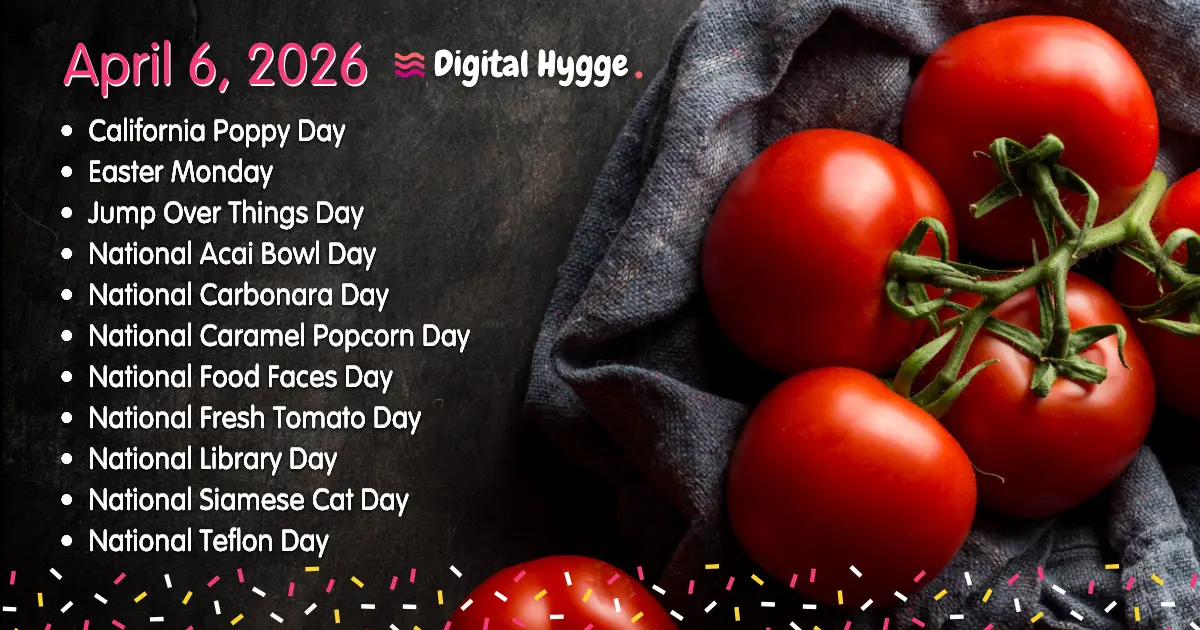
Here’s every observance celebrated on April 6, 2026.
National & International Days on April 6
Whether you’re celebrating Easter Monday with family, cooking a proper carbonara, wearing tartan, jumping over things, or quietly planning your epitaph, there’s something on this list for everyone. Here’s the story behind each of these April 6 celebrations.
Army Day
🇺🇸 Army Day was founded in 1928 by Colonel Thatcher Luquer of the Military Order of the World War, who chose May 1 as the date specifically to counter the Communist celebration of International Workers’ Day, which falls on the same day. Starting in 1929, it was moved to April 6 to mark the anniversary of the United States’ entry into World War I.
Bohring-Opitz Syndrome Awareness Day
Bohring-Opitz Syndrome Awareness Day shines a light on Bohring-Opitz Syndrome (BOS), an ultra-rare genetic condition affecting an estimated 150 to 200 people worldwide. The day was first organized in 2015 by Taylor Gurganus, co-founder of the BOS Foundation, and April 6 was chosen to mark the anniversary of the first online support group for BOS families, which helps parents and caregivers connect with others who share their experience. To show support, people are encouraged to wear gold and denim — gold because many children with BOS are drawn to shiny, bright objects, and denim because it is a recognized symbol for rare diseases.
California Poppy Day
California Poppy Day honors the California poppy, the state’s official flower. The California Legislature adopted the poppy as the state flower on March 2, 1903, and seventy years later, in 1973, the law was amended to designate April 6 as California Poppy Day. The day is a chance for Californians and nature lovers everywhere to appreciate one of the state’s most iconic wildflowers.
Drowsy Driver Awareness Day
Drowsy Driver Awareness Day highlights the very real dangers of getting behind the wheel while tired. The day was established after Phil Konstantin, a retired California Highway Patrol officer, lost his wife Robyn in 1999 when she fell asleep at the wheel. He pushed for California to recognize an annual Drowsy Driver Awareness Day, which was established in 2005. The day raises awareness that drowsy driving is far more dangerous than most people realize. Staying awake for around 18 hours can impair driving ability to a degree similar to having a blood alcohol content of 0.05%, and after 24 hours without sleep, that impairment rises to the equivalent of 0.10%, above the legal limit in all states.
Easter Monday
Easter Monday* (Monday after Easter) is the day after Easter Sunday, and for Christians it continues the celebration of Jesus Christ’s resurrection from the dead which is the central event of the Christian faith. The tradition of extending the celebration into Monday dates back to the early church, when the Easter festivities were observed for an entire week. Today it is a public holiday in more than 50 countries, including the UK, Ireland, Australia, Canada, and much of Europe, though not in the United States.
Hostess Twinkie Day
Hostess Twinkie Day Hostess Twinkie Day marks the date in 1930 when plant manager James Dewar invented the Twinkie at a bakery in River Forest, Illinois, making it one of the most widely recognized snacks in American history. The holiday gained attention during Hostess’s 2012 bankruptcy and was first celebrated that same year.
International Asexuality Day
International Asexuality Day has been observed every April 6 since 2021, when a committee of people from different countries spent almost a year planning the inaugural event. The day raises awareness of asexuality, an orientation describing people who experience little or no sexual attraction, and places a particular focus on asexual experiences outside the Western, English-speaking world, where most public discussion of the topic has historically been centered.
International Day of Sport for Development and Peace
International Day of Sport for Development and Peace commemorates the opening of the first modern Olympic Games in Athens in 1896. Declared by the United Nations General Assembly in 2013, the day recognizes the role sport can play in advancing human rights, social development, and peace, and serves as an annual reminder that competition, fair play, and shared participation can connect communities across cultural and national boundaries.
Jump Over Things Day
Jump Over Things Day is an excuse to get moving. The idea is to find something to jump over — a puddle, a box, a garden fence — and do it. No special skills or equipment required, just a willingness to be a little silly and get off the couch.
National Acai Bowl Day
National Acai Bowl Day was established in 2013 by Sambazon, the company credited with introducing acai to the American market. The acai bowl itself was popularized by the Gracie family, known for their Brazilian jiu-jitsu gyms, who developed it in the late 1980s as part of their approach to nutrition. The day is a great invitation to explore this tasty dish if you have never tried one before.
National Carbonara Day
National Carbonara Day was created in 2017 by the Italian Association of Confectionery and Pasta Industries and the International Pasta Organization to celebrate one of Italy’s most beloved yet most debated pasta dishes. Despite having only a handful of ingredients, carbonara inspires strong opinions about how it should properly be made, and versions of it have spread and evolved across the world. The day is an invitation to make it, eat it, and join the conversation about how it should actually be done.
National Caramel Popcorn Day
National Caramel Popcorn Day celebrates one of America’s most popular snacks. ts origins trace back to Frederick and Louis Rueckheim, two German immigrant brothers who began experimenting with popcorn, peanuts, and molasses at their Chicago store in the 1870s, eventually giving rise to Cracker Jack. It is a good excuse to enjoy a sweet and crunchy treat that has stood the test of time.
🍿 Other popcorn-themed holidays are: Business of Popping Corn Day on December 2 and National Popcorn Lover’s Day on Second Thursday in March and National Popcorn Day on January 19
National Fresh Tomato Day
National Fresh Tomato Day celebrates one of the most unexpectedly triumphant foods in history. For centuries, Europeans believed tomatoes were poisonous and avoided them entirely, yet they eventually became a cornerstone of kitchens and cuisines all over the world. The day is an invitation to appreciate the tomato in its simplest form, fresh and at its best, whether on a sandwich, in a salad, or eaten straight off the vine.
National Food Faces Day
National Food Faces Day is a playful holiday that invites anyone to arrange a few ingredients into a face and see what happens. The day was created by Holland America Line in 2021, inspired by Master Chef Rudi Sodamin, who began making edible portraits from vegetables, fruit, meats, and other ingredients to entertain his kitchen team. The observance invites individuals to get creative with food, whether you make something silly, surprising, or unexpectedly beautiful.
National IEP Writing Day
National IEP Writing Day* (First Monday in April) was established in 2022 by The Intentional IEP to recognize the work that goes into creating Individualized Education Programs, known as IEPs. In the United States, public schools are legally required to develop an IEP for every student who qualifies for special education services, and each one is a detailed, personalized plan outlining the specific instruction, accommodations, and support that child needs to succeed in school. Writing a single IEP takes special education teachers anywhere from one to four hours, and many write dozens of them each school year. The day is a chance to acknowledge that often invisible workload and thank the teachers, specialists, and families who collaborate to get it done.
National Library Day
National Library Day is a reminder that libraries are one of the few truly public spaces where everyone is welcome, regardless of background or income. They offer free access to knowledge, technology, and community, things that can make a real difference in people’s lives. Whether you have not visited in a while or have never had a library card, this day is a good moment to explore what your local library has to offer.
📚 See also: National Library Week* (April 19-25, 2026), National School Librarian Day (April 4), National Library Outreach Day (April 10), and National Librarian Day (April 16)
National Siamese Cat Day
National Siamese Cat Day was founded in 2014 by writer Jace Shoemaker-Galloway to celebrate one of the most beloved and recognizable cat breeds in the world. The day shines a spotlight on Siamese cats and their famously striking looks and outgoing personalities, while also encouraging people to consider adopting one from a shelter.
National Sorry Charlie Day
National Sorry Charlie Day was founded in 1992 by Cathy Runyan-Svacina. It takes its name from Charlie the Tuna, the StarKist mascot who famously kept getting rejected, yet kept showing up anyway. Runyan-Svacina saw something deeply relatable in that and created the day to remind us that rejection, in all its forms, is a near-universal human experience.
National STUDENT-Athlete Day
National STUDENT-Athlete Day was founded in 1987 by the Institute for Sport & Social Justice to celebrate high school and college students who successfully balance competitive athletics with strong academic performance and community involvement. Over 4.4 million student-athletes have been recognized since its founding.
National Tartan Day
National Tartan Day commemorates the signing of the 1320 Declaration of Arbroath and celebrates Scottish-American heritage. The day takes its name from tartan, the distinctive patterned woollen cloth long associated with Scotland. The observance began in Nova Scotia, Canada, in 1987, and from there spread to Australia, the United States, and beyond. In the US, it was made official in 2008.
National Teflon Day
National Teflon Day honors the accidental discovery of Teflon by Dr. Roy Plunkett on April 6, 1938 while he was working as a chemist at DuPont lab. The day recognizes Teflon’s role in cookware, medicine, aerospace, and industrial innovation. Dr. Plunkett was inducted into the Inventors Hall of Fame in 1985.
New Beer’s Eve
New Beer’s Eve commemorates the night of April 6, 1933, when Americans lined up outside breweries and taverns to buy beer legally for the first time in over a decade, as the Cullen-Harrison Act was set to take effect at midnight. The day marks that moment and the end of Prohibition-era restrictions on low-alcohol beer, signed into law by President Franklin D. Roosevelt, who remarked upon signing it, “I think this would be a good time for a beer.”
🍻 See also: National Beer Day on April 7 as well as the complete list of national days dedicated to alcohol drinks.
Plan Your Epitaph Day
Plan Your Epitaph Day, observed on April 6 and November 2, was created in 1995 by Lance Hardie, a radio producer from Arcata, California. The dates were chosen to align with two traditions of honoring the dead (the Chinese Qingming Festival and the Mexican Day of the Dead). An epitaph is the short inscription on a gravestone, and Hardie’s idea was that rather than leaving those words to someone else, why not choose them yourself. As he put it, “It’s your life — it’s your death — it’s your stone. You say something!“