


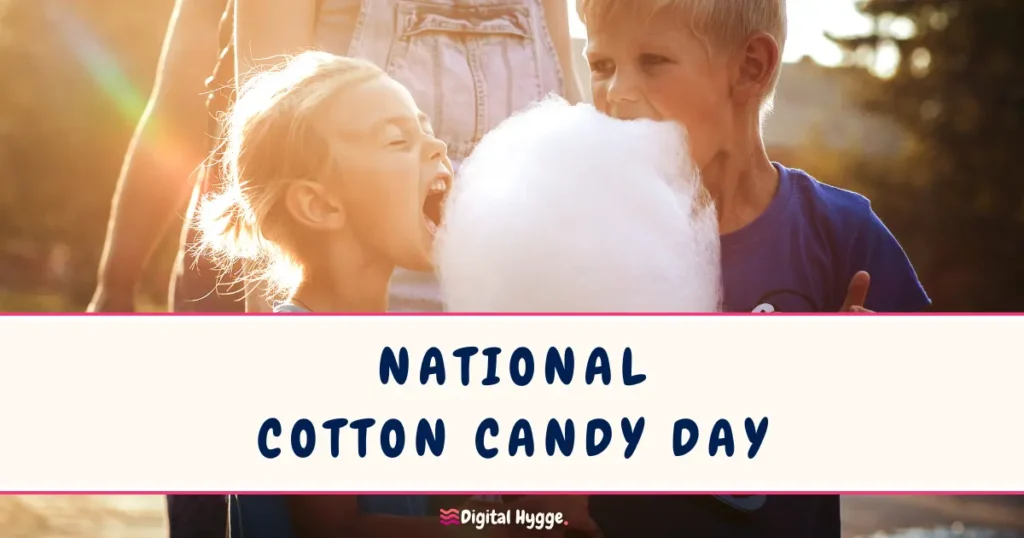

National Cotton Candy Day, observed on December 7, highlights the history of one of the most recognizable fairground sweets. Although various sugar confections existed long before, the modern version of cotton candy depends on a machine that spins melted sugar through tiny openings, creating thin strands that cool instantly and form a light, cloud-like texture. This method was developed in 1897 by dentist William Morrison and confectioner John C. Wharton, who patented their device and introduced the product to a wide audience at the 1904 St. Louis World’s Fair. Visitors were fascinated by the new type of treat, and its popularity grew quickly.
The name varies across countries—cotton candy in the United States, candy floss in the United Kingdom, and fairy floss in Australia—but the production process remains largely the same. Over time, new colors and flavors were added, and cotton candy became a regular treat at fairs, festivals, amusement parks, and sporting events.
When is National Cotton Candy Day?
National Cotton Candy Day is observed every year on December 7, giving it a fixed place in the early winter season. This consistent date makes it easy to remember and plan for.
| Year | Date |
|---|---|
| 2025 | December 7, Sunday |
| 2026 | December 7, Monday |
| 2027 | December 7, Tuesday |
| 2028 | December 7, Thursday |
| 2029 | December 7, Friday |
| 2030 | December 7, Saturday |
You can also celebrate similar food observances such as National Cookie Day on December 4 and National Cocoa Day on December 13.
Lesser-Known Facts About Cotton Candy
- Early spinning machines were hand-cranked. Before electric models became standard, some early cotton candy machines required operators to turn a crank to spin the sugar threads.
- Cotton candy was once considered a luxury. When it debuted at the 1904 St. Louis World’s Fair, the price was 25 cents—a significant cost at the time—but it still sold more than 68,000 boxes.
- Modern machines melt sugar at extremely high temperatures. Cotton candy forms when sugar is heated to about 300°F (150°C) and spun into thin strands that cool almost instantly in the air.
- One serving is mostly air. Despite its size, cotton candy contains relatively little sugar by weight (just a few teaspoons which is less than a can of soda) because the spinning process creates thousands of fine, airy threads.
- Natural colors are increasingly used today. Many producers now use colorants derived from fruits and vegetables to create pinks, blues, and purples without synthetic dyes.
- There are more flavor options than many people realize. Beyond the familiar pink-vanilla and blue-raspberry varieties, cotton candy comes in flavors like grape, watermelon, bubble gum, and even maple.
- The largest cotton candy sculpture weighed an impressive 16.783 kg (37 lbs)! It was created on April 8, 2022, in Austin, Texas, by a team of YouTubers, including Ali Spagnola, Brian Brushwood, and Jason Murphy (of The Modern Rogue).
Ways to Celebrate National Cotton Candy Day
National Cotton Candy Day lends itself to easy, low-cost activities that highlight the treat’s history and unique texture. Here are a few ideas to try, if you want to join in.
- Try a classic flavor. Pick up pink or blue cotton candy from a fair stand, grocery store, or local vendor and enjoy it fresh.
- Explore new varieties. Look for less common flavors such as grape, watermelon, or maple, or try cotton candy made with natural colorants.
- Make cotton candy at home. Use a countertop machine if you have one, or watch how it’s made to learn about the spinning process.
- Learn about its invention. Read about the 1897 cotton candy machine patent or the 1904 World’s Fair to understand how the treat became popular.
- Share your creations online. It’s an easy way to join others celebrating the day and explore how people enjoy cotton candy around the world.