


January 16, 2026, is the 16th day of the year, with 349 days remaining, and it falls on a Friday in the third week of the year.
The date highlights publishing and the role of books in sharing knowledge, alongside observances that promote nutritious foods such as quinoa and rooibos tea. It also recognizes positive contributions by teenagers and includes reflections on progress in medicine and public health, balancing lighter food-focused celebrations with themes of learning, well-being, and social awareness.
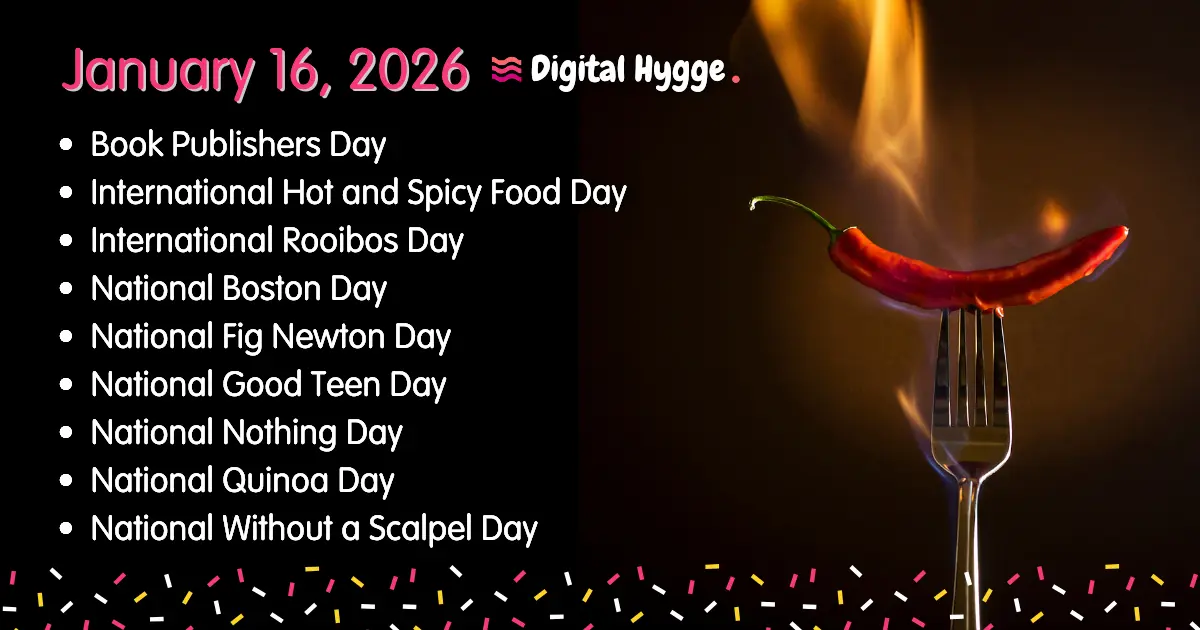
Below is a list of all 12 national and international days observed on January 16, each explained briefly.
National & International Days on January 16
Appreciate a Dragon Day is a literacy-focused observance that uses dragons as a gateway to reading and storytelling. It was founded in 2004 by fantasy author Donita K. Paul alongside the release of her novel DragonSpell, encouraging readers of all ages to explore books, visit libraries, and learn how dragons appear in myths and literature as symbols of imagination, meaning, and cultural tradition.
Book Publishers Day recognizes the work that turns a manuscript into a finished book. Launched in 2020 by the Association of American Publishers and the Book Industry Charitable Foundation, with support from the literacy nonprofit First Book, the observance highlights the often unseen roles of editors, designers, printers, and distributors, while emphasizing how publishers help expand literacy, access to books, and the sharing of ideas across cultures.
📚 Discover the ultimate list of bookish national days and months and celebrate your love for reading all year round! 🎉📖✨
International Hot and Spicy Food Day highlights cuisines where heat plays a central role in flavor and tradition. Observed since the early 2000s, with January 16 gaining wider recognition around 2012, it encourages people to explore spicy dishes from different cultures, such as Indian vindaloo or Sichuan mapo tofu, while drawing attention to capsaicin—the natural compound responsible for spiciness and its commonly discussed effects on metabolism and inflammation.
International Rooibos Day, also known as National Rooibos Day, celebrates South Africa’s indigenous rooibos tisane and the people and traditions behind it. The observance was founded on January 16, 2017, by Sanet Stander and Marietjie Smit of the Rooibosteahouse and began as a local community event in Clanwilliam. Today, it is promoted by the South African Rooibos Council to raise awareness of rooibos as a naturally caffeine-free, antioxidant-rich drink and to highlight its cultural importance, including its status as the first African food granted Protected Designation of Origin recognition by the European Union.
🫖 For tea lovers, other days that might be fun to celebrate include:
- National Hot Tea Day in January
- International Tea Day in May
- National Tea Day in April
- National Chai Day in September
National Boston Day celebrates both the city of Boston and the name Boston. It marks the city’s founding in 1630, when English settlers named it after Boston in England, and highlights its role in early American history, including the American Revolution. The observance also acknowledges people around the world named Boston and is distinct from One Boston Day on April 15, which focuses on community unity after the 2013 Boston Marathon tragedy.
➡️ National Boston Cream Pie Day is observed annually on October 23.
National Fig Newton Day recognizes the creation of the Fig Newton in 1891. The recipe is credited to baker Charles Roser, while large-scale production became possible after James Henry Mitchell invented a machine that could fill cookies efficiently. The observance highlights the snack’s early reputation as a fruit-based health food and acknowledges Nabisco, which later trademarked the name after Newton, Massachusetts.
National Good Teen Day highlights positive actions and achievements by teenagers, challenging common negative stereotypes. It was founded in 1992 by students and teachers at Salem City Schools to encourage recognition of responsible and caring behavior among teens. The observance gained national status in 1995 after the United States Congress passed supporting legislation, leading Bill Clinton to officially proclaim the day.
National Nothing Day is an intentional anti-holiday that encourages people to take a break from celebrations, expectations, and obligations. It was proposed in 1972 by Harold Pullman Coffin as a response to the growing number of themed holidays, offering a single day meant for rest, disengagement, or simply leaving the calendar empty.
National Quinoa Day highlights quinoa as a nutritious, sustainable food and its role in modern diets. The observance gained wider attention after the United Nations named 2013 the International Year of Quinoa, helping introduce the crop to a global audience. It emphasizes quinoa as a complete protein with all nine essential amino acids and acknowledges the Indigenous communities of the Andes Mountains, who have grown and relied on quinoa for thousands of years.
National Religious Freedom Day commemorates the 1786 adoption of the Virginia Statute for Religious Freedom, written by Thomas Jefferson and championed by James Madison. The law ended government support of religion in Virginia and later influenced the First Amendment. The modern observance, established by a U.S. presidential proclamation in 1993, affirms the right to practice any faith—or none—without government interference.
National Without a Scalpel Day focuses on modern treatments that replace open surgery with minimally invasive, image-guided procedures. Founded in 2015 by The Interventional Initiative, it is observed on January 16 to commemorate the 1964 angioplasty performed by Charles Dotter, who used X-ray guidance to open a blocked artery without surgery. The observance helps patients understand that conditions such as vascular disease, stroke, and chronic pain can often be treated with lower risk, reduced discomfort, and quicker recovery times.
Prohibition Remembrance Day marks the 1919 ratification of the Eighteenth Amendment, which banned alcohol production and sales in the United States. It reflects on the reform movement led by groups such as the Women’s Christian Temperance Union and the Anti-Saloon League, and examines the long-term effects of Prohibition, including illegal alcohol trade, organized crime, and public resistance to federal law.
🍹 Explore national days and months dedicated to reducing alcohol consumption and promoting sobriety. Find inspiration and support for a healthier lifestyle!
National Days in January
January 1 | January 2 | January 3 | January 4 | January 5 | January 6 | January 7 | January 8 | January 9 | January 10 | January 11 | January 12 | January 13 | January 14 | January 15 | January 16 | January 17 | January 18 | January 19 | January 20 | January 21 | January 22 | January 23 | January 24 | January 25 | January 26 | January 27 | January 28 | January 29 | January 30 | January 31
➡️ Have you already seen DigitalHyyge’s National Days Calendar?
➡️ Complete list of January National Days
➡️ Complete list of February National Days
➡️ Curious to see more national and international celebrations? We have dozens of national days lists curated for you!