

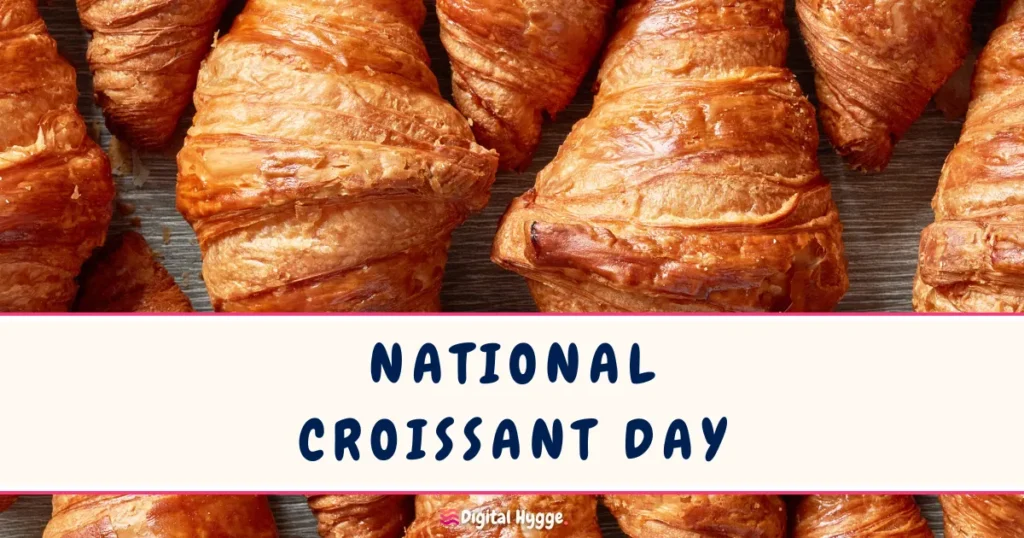

National Croissant Day is celebrated annually on January 30. The observance highlights the croissant’s journey from its Austrian inspiration to becoming a symbol of French baking, while also drawing attention to its many forms and flavors. It also recognizes the meticulous lamination technique that creates the pastry’s thin layers and airy texture.
The day is often marked by enjoying a classic croissant au beurre or exploring modern variations. Popular hybrids include the cronut, a croissant–donut pastry; the cruffin, baked in a muffin shape; the croffle, pressed in a waffle iron; the crookie, filled with cookie dough; flaffins, flattened and crisp; and playful creations such as croissant tacos.

When is National Croissant Day Celebrated?
National Croissant Day is celebrated every year on January 30. The date stays the same annually, making it easy to plan ahead for enjoying a classic croissant or trying creative variations. Here’s when National Croissant Day falls in the coming years.
| Year | Date |
|---|---|
| 2025 | January 30, Thursday |
| 2026 | January 30, Friday |
| 2027 | January 30, Saturday |
| 2028 | January 30, Sunday |
| 2029 | January 30, Tuesday |
| 2030 | January 30, Wednesday |
Facts About Croissants
Here are a few interesting facts that you probably never hear of.
- Croissants aren’t technically French: The croissant is a descendant of the Austrian kipferl. It did not arrive in Paris until 1839, when Austrian baker August Zang opened the Boulangerie Viennoise. French bakers later adapted the dough into the laminated, layered style eaten today, which is why croissants are classified as viennoiserie.
- A crescent with historical meaning: According to legend, the crescent shape dates to 1683, when Viennese bakers created it to mock the Ottoman Empire. After hearing Ottoman troops tunneling under Vienna’s walls at night, bakers alerted the army, and following the victory, pastries shaped like the Ottoman crescent moon were baked so citizens could symbolically eat their enemies.
- Croissant shape signals ingredients: In France, the croissant’s shape often indicates what it is made from. A straight croissant (croissant au beurre) must contain 100% butter, while a curved croissant (croissant ordinaire) is typically made with margarine or other fats. Pain au chocolat, a flaky pastry similar to a croissant but rectangular in shape, is filled with chocolate, while pain aux raisins is circular and filled with pastry cream and raisins.
- They started as fast food: Until the early 20th century, croissants were a luxury item for the wealthy. They became widely accessible in the 1970s with the development of frozen, pre-laminated dough, allowing bakeries and cafés to bake them quickly without a master pastry chef on site.
- The honeycomb texture: A perfect croissant is a marvel of engineering. To get those airy layers, a baker typically folds the dough to create 55 layers of butter between 56 layers of dough. If the butter is even one degree too warm, it melts into the dough and the shatter is lost.

How People Celebrate National Croissant Day
From grabbing a freshly baked croissant at your favorite bakery to experimenting with your own creations at home, there are many ways to celebrate National Croissant Day.
- Visit your local bakery and enjoy a freshly baked croissant.
- Try making croissants at home by following one of the many recipes available online or using frozen dough.
- Experiment with fillings—ham and cheese for a savory option or Nutella for something sweet.