

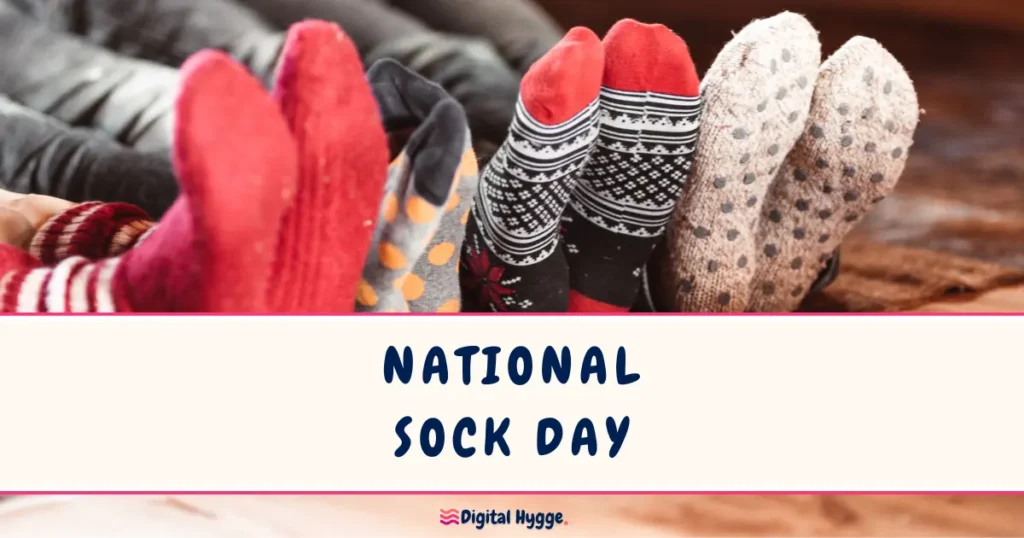

National Sock Day is observed each year on December 4. It was created in 2016 by the apparel company Pair of Thieves to highlight an everyday item that keeps people warm, comfortable, and ready for the day.
The day also connects to a real need in many communities. Shelters routinely ask for new socks because they wear out quickly and people in need often have limited access to clean pairs. For this reason, companies involved in the day often organize campaigns that provide socks directly to shelters, and many individuals choose the date as a reminder to donate a few pairs themselves.
As the observance has grown, it has developed a small but steady online presence. People share photos of colorful or seasonal socks, pick up a new pair for winter, support companies involved in charity campaigns, or drop off socks at a local shelter.
As of November 2025, the hashtag #NationalSockDay appears in about 5,000 Instagram posts.
When Is National Sock Day Observed?
National Sock Day is observed on the same date every year—December 4. A fixed day makes planning simple for organizations, shelters, and anyone who wants to take part. It also aligns with early December, when colder weather sets in and warm socks become part of everyday routines. Here is a table with the dates and weekdays for National Sock Day through 2030:
| Year | Date |
|---|---|
| 2025 | December 4, 2025 (Thursday) |
| 2026 | December 4, 2026 (Friday) |
| 2027 | December 4, 2027 (Saturday) |
| 2028 | December 4, 2028 (Monday) |
| 2029 | December 4, 2029 (Tuesday) |
| 2030 | December 4, 2030 (Wednesday) |
How to Celebrate National Sock Day
National Sock Day is one of the simplest observances to take part in because it doesn’t require anything special or time-consuming. Early December is cold in many places, people are pulling out their winter clothes, and socks are something everyone uses yet rarely thinks about. Here are some easy ways to join in:
- Donate new socks to a local shelter. Socks are one of the most needed items year-round.
- Support a brand that gives back. Companies like Bombas and Stand4 Socks donate a pair for every pair sold.
- Refresh your own sock drawer. Buy one or two pairs you’ll actually wear all winter.
- Wear a fun pair to school or work. Bright patterns, holiday prints, anything that feels “you.”
- Give someone a small sock-themed gift. Warm winter socks make an easy, practical present.
- Share your favorite pair online with the hashtag #NationalSockDay. A simple photo helps the day spread.
Lesser-Known Facts About Socks
Socks seem simple, but their history and everyday role are far more interesting than most people realize. These facts offer a quick look at how socks developed, why they matter, and how they remain connected to culture, technology, and daily comfort.
- Some of the oldest socks ever found come from ancient Egypt. They are more than 1,500 years old and were made with a split toe so they could be worn with sandals.
- Early “socks” looked very different from what we know today. People used foot coverings made from felted wool, animal hides, or other natural materials long before knitting existed.
- The first knitting machine changed how socks were produced. Invented in 1589, it made sock-making faster and created more consistent sizes.
- Wool was the main sock material for centuries. Cotton only became common once large-scale manufacturing made it easier to produce and buy.
- Modern elastic fibers reshaped sock comfort. Nylon in the 1930s and spandex in the 1950s helped socks stretch and stay in place throughout the day.
- Compression socks began in medicine. They were designed to improve circulation and later became useful for long flights, standing for long hours, and athletic recovery.
- Socks wear out quickly for a simple reason. Constant friction inside shoes makes them one of the most frequently replaced clothing items.
- Lost socks are more common than people think. A UK survey once estimated that the average household loses around 15 socks a year.
- Sock color once reflected social status. In medieval Europe, brightly dyed or finely made socks signaled higher social standing.
- Mismatched socks carry meaning in many settings. Some people wear them for fun, while others do it to support awareness efforts such as World Down Syndrome Day on March 21.