

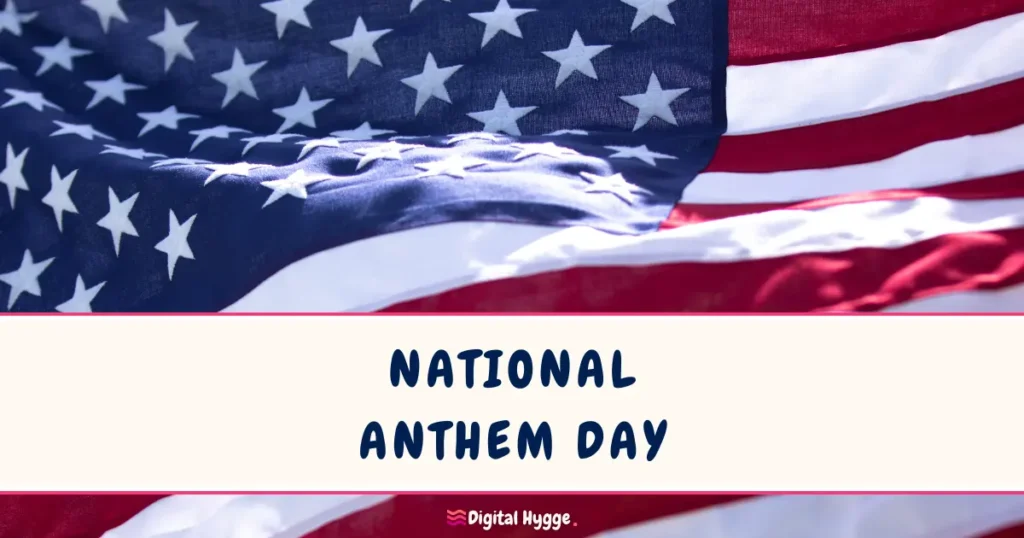

National Anthem Day is celebrated annually on March 3 in the United States, marking one of the most significant moments in American musical history. The date commemorates 1931, when President Herbert Hoover signed a congressional resolution officially designating “The Star-Spangled Banner” as the nation’s anthem.
National Anthem Day is celebrated annually on March 3 in the United States, marking one of the most significant moments in American musical history. The date commemorates 1931, when President Herbert Hoover signed a congressional resolution officially designating “The Star-Spangled Banner” as the nation’s anthem — a song that had already been stirring hearts for over a century.
It’s a wonderful occasion to pause, reflect on the story behind the music, and appreciate the way a single song can carry the weight of a nation’s identity.
Background of the National Anthem
The roots of “The Star-Spangled Banner” go back to the War of 1812. Francis Scott Key, a lawyer and amateur poet, witnessed the British bombardment of Fort McHenry in Baltimore on the night of September 13–14, 1814. When dawn broke and the American flag was still flying above the fort, Key was so moved that he scribbled the words of a poem on the back of a letter. That poem — originally titled Defence of Fort M’Henry — was soon set to music and spread quickly across the country.
Despite its popularity, the song had no official status for more than a hundred years. It was often performed at public events and military ceremonies, but it wasn’t until a long campaign by veterans’ groups and civic organizations that Congress finally acted. On March 3, 1931, President Hoover made it official, and the rest is history.
Facts About the Anthem
- The song actually has four verses, though almost everyone only knows the first. The final verse ends with the now-famous line: “the land of the free and the home of the brave.”
- The melody was borrowed from a popular British social club song called “To Anacreon in Heaven” — proof that great anthems sometimes have unexpected origins!
- Whitney Houston’s performance at Super Bowl XXV in 1991 is widely regarded as one of the greatest renditions ever recorded — and it charted as a pop single twice, in 1991 and again after 9/11.
- Jimi Hendrix’s legendary guitar version at Woodstock in 1969 remains one of the most talked-about performances in music history.
National Anthems Around the World
The United States isn’t alone in having a special relationship with its anthem. Countries around the world treasure these songs as powerful symbols of shared identity.
One of the world’s shortest national anthems — just 32 characters of text.
Technically the longest anthem in the world, with 158 verses — though only the first two are sung officially.
Performed for over a century before being officially adopted as the national anthem in 1980.
At nearly five minutes long, it is one of the world’s longest national anthems by duration.
🎶 While the melodies and stories differ, the impulse to capture a nation’s spirit in song is truly universal.
Ways to Celebrate National Anthem Day
There are so many fun ways to mark the occasion! Here are a few ideas:
- Listen and explore: Start with “The Star-Spangled Banner,” then go down a rabbit hole of famous performances. You might be surprised by what you discover.
- Learn the full song: Most people only know the first verse. Reading all four is a fascinating experience.
- Teach the history: National Anthem Day is a great excuse to share the story of Francis Scott Key and Fort McHenry with kids or students.
- Go global: Spend an evening exploring national anthems from around the world. It’s a surprisingly moving experience.
- Share on social media: Post your favorite performance or a fun fact using #NationalAnthemDay.
However you choose to celebrate, take a moment to appreciate the remarkable story behind the song and the enduring power of music to bring people together.
🎵 National Anthem Day Upcoming Dates
National Anthem Day is observed every year on March 3. The date remains the same, while the weekday changes.
| Year | Date | Day |
|---|---|---|
| 2026 | March 3 | Tuesday |
| 2027 | March 3 | Wednesday |
| 2028 | March 3 | Friday |
| 2029 | March 3 | Saturday |
| 2030 | March 3 | Sunday |